
Palmistry Lines Meaning: Life, Head and Heart Line Explained
What Do the Life Line, Head Line and Heart Line Mean in Palmistry?
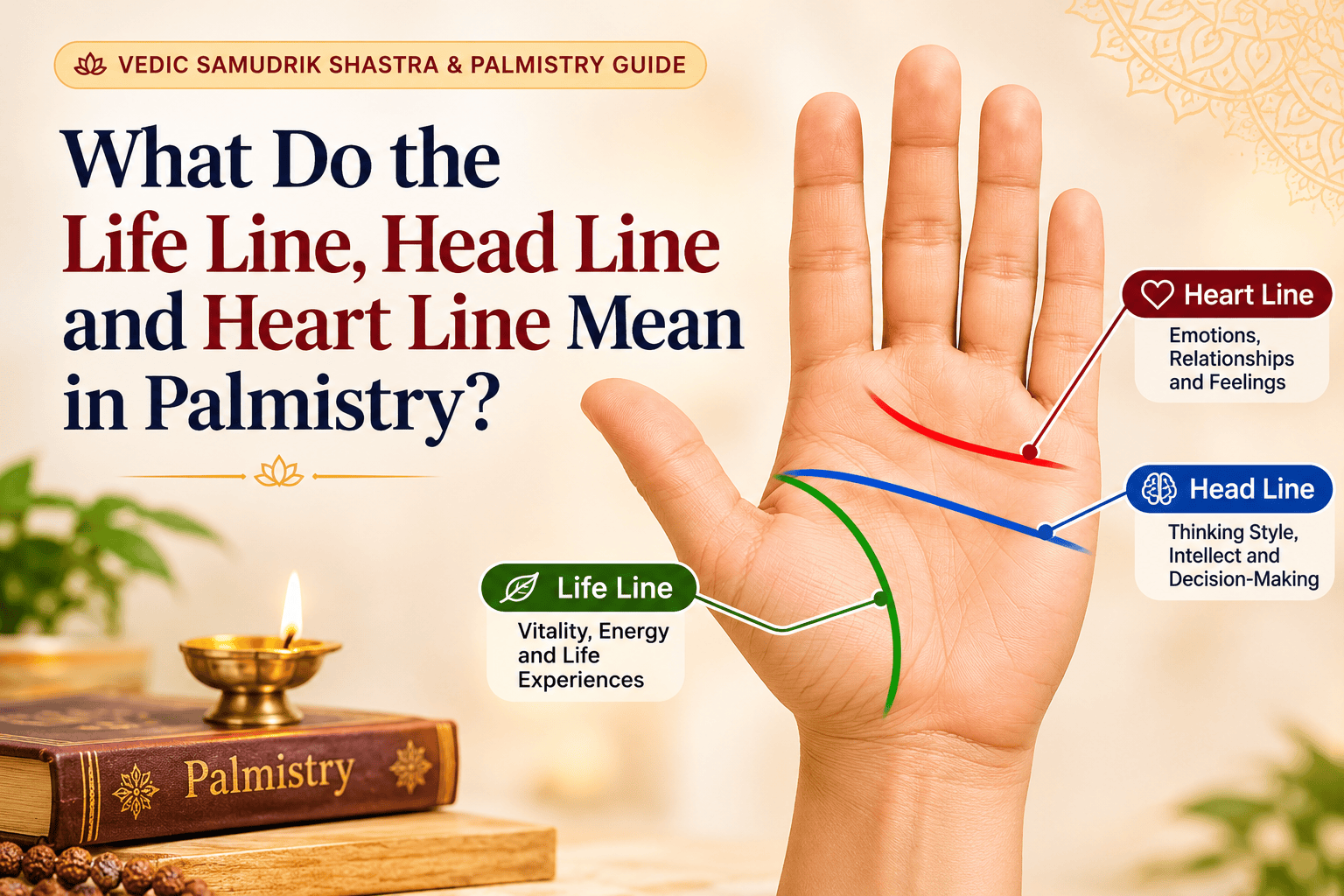
Have you ever looked at your palm and wondered what those lines actually mean? You are not alone. Many people become curious about palmistry after noticing the different lines running across their hands.
Palmistry, also known as palm reading or chiromancy, is a traditional practice that interprets the lines, shapes and mounts of the hand. In addition, it has been practised in India as Samudrik Shastra and in many other parts of the world for generations.
When exploring palmistry lines meaning, most beginners start with three major lines: the Life Line, Head Line and Heart Line. Each has its own traditional interpretation and is considered an important part of a palm reading.
However, what does each line represent? Does a short Life Line mean a shorter life? Furthermore, should you read your left or right hand?
In this guide, we will explore where these lines are located, what their different patterns traditionally mean, and how palmists interpret them together. Therefore, keep in mind that palmistry is a traditional belief system, not a scientifically proven method of predicting personality or future events.
What Are the Three Major Lines in Palmistry?
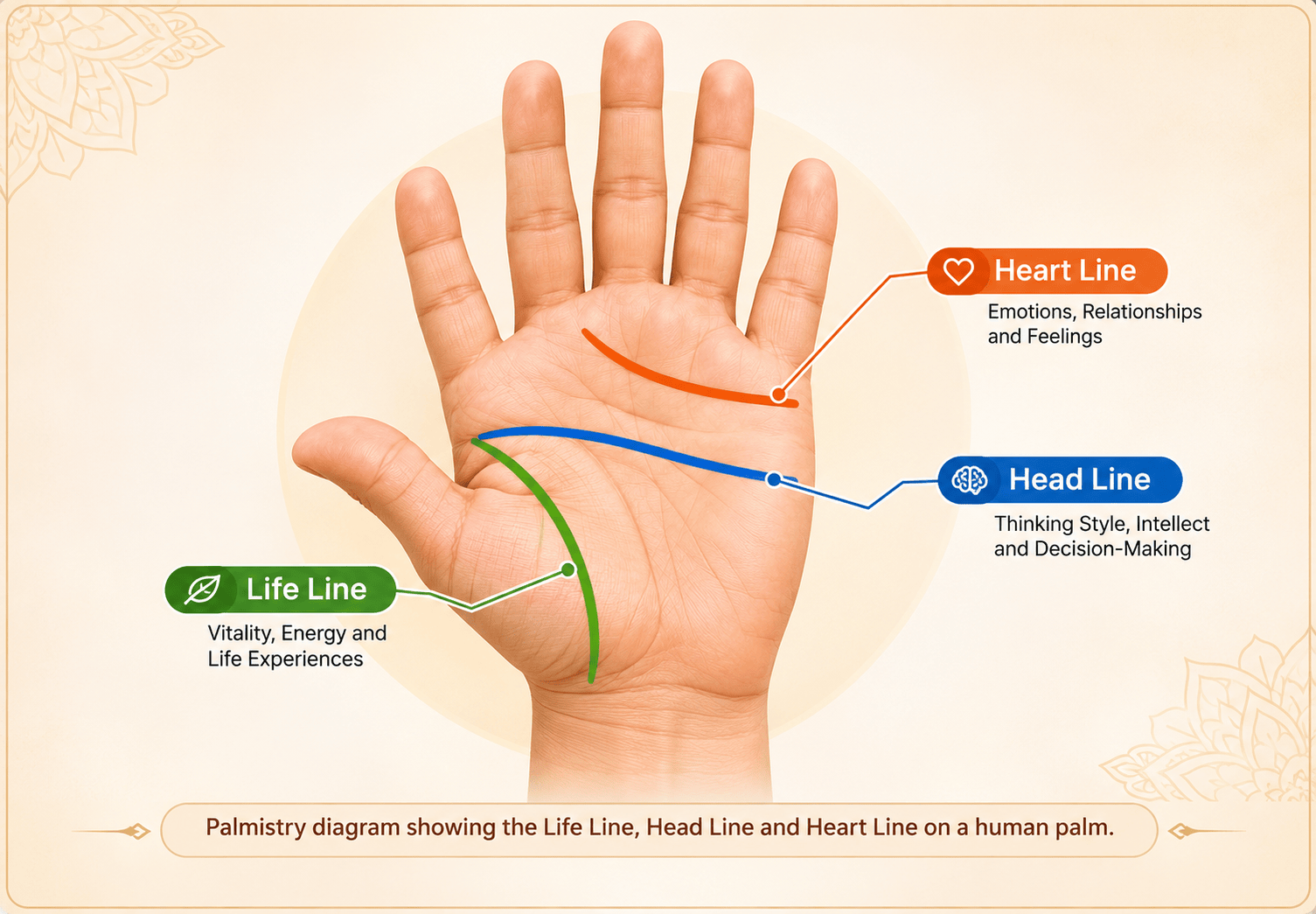
The three major lines are among the first features a palmist examines. In traditional palmistry, each line is associated with a different aspect of life:
Moreover, these lines are not interpreted in isolation. Palmists also consider the shape of the hand, mounts, minor lines and other features before forming an overall interpretation.
What Does the Life Line Mean in Palmistry?
The Life Line is one of the most recognisable lines on the palm. Therefore, it is often the first line people look for when learning how to read their hands.
In traditional palmistry, it is associated with vitality, energy and important experiences throughout life. However, its length should never be treated as a measurement of lifespan.
Where Is the Life Line Located?
The Life Line usually begins near the space between the thumb and index finger. Furthermore, it curves around the base of the thumb, passing around the fleshy area known as the Mount of Venus, and continues towards the wrist.
Its shape, depth and overall appearance are traditionally considered during a palm reading.
What Does a Long or Short Life Line Mean?
A long, clearly visible Life Line is traditionally associated with vitality, stamina and an active approach to life.
On the other hand, a shorter Life Line may have different interpretations depending on the palmistry tradition. However, a short Life Line does not mean a short lifespan. The line is not considered a reliable indicator of how long someone will live.
Consequently, this remains one of the most common misunderstandings in popular palm reading.
What Does a Deep or Faint Life Line Mean?
The depth and visibility of the Life Line are also considered in traditional palm reading:
- Deep and clear Life Line: Often associated with vitality, resilience and steady energy.
- Faint or light Life Line: Sometimes interpreted as sensitivity or changing energy levels.
As a result, these are traditional interpretations rather than established facts about a person's physical health.
What Does a Broken Life Line Mean?
A broken Life Line is traditionally associated with a significant change or transition in life.
For example, some palmists interpret it as a shift in lifestyle, surroundings, career or personal circumstances. Similarly, the meaning may depend on the exact position and appearance of the break.
Therefore, a break should not automatically be considered a negative sign or a prediction of misfortune.
What Do Chained and Forked Life Lines Mean?
Different line patterns can add further detail to a traditional palm reading:
- Chained Life Line: A line that looks like a series of small links is traditionally associated with periods of uncertainty or changing circumstances.
- Forked Life Line: In contrast, a line that divides into two branches near the end is sometimes interpreted as a change in direction, location or lifestyle.
Moreover, the interpretation can vary between regional palmistry traditions.
What Does the Head Line Mean in Palmistry?
The Head Line is traditionally connected with a person's thinking style and approach to making decisions.
Palmists examine its length, direction and appearance to understand what these features may represent within the traditional practice.
Where Is the Head Line Located?
The Head Line generally begins near the area between the thumb and index finger, often close to the starting point of the Life Line.
It runs across the palm below the Heart Line. In some hands, the two lines begin close together, while in others, they appear distinctly separated.
What Does a Long or Short Head Line Mean?
The length of the Head Line is traditionally interpreted in different ways:
- Long Head Line: Often associated with detailed thinking, careful planning and considering different possibilities.
- Short Head Line: Traditionally linked with a direct, practical and straightforward approach to thinking.
However, a shorter Head Line does not indicate lower intelligence. Palmistry interpretations should never be used to judge someone's intellectual ability.
What Does a Straight or Curved Head Line Mean?
The direction of the Head Line is another feature considered during palm reading:
- Straight Head Line: Traditionally associated with logical, practical and focused thinking.
- Curved or sloping Head Line: On the other hand, a curved line is often linked with imagination, creativity and an intuitive approach.
Neither pattern is considered superior to the other. Rather, they simply reflect different perspectives in palmistry lines meaning.
What Does a Broken Head Line Mean?
A break in the Head Line is traditionally interpreted as a shift in thinking, priorities or personal direction.
For instance, some palmists associate it with a period of reconsidering goals or approaching situations differently. However, a broken line does not prove that a person will experience a particular difficulty.
What Do Forked and Chained Head Lines Mean?
- Forked Head Line: A line dividing into branches (often called a writer’s fork) is associated with the ability to consider diverse viewpoints.
- Chained Head Line: Additionally, a line with several linked sections is interpreted as periods of scattered focus or restless thoughts.
What Does the Heart Line Mean in Palmistry?
The Heart Line is traditionally associated with emotions, relationships and the way a person expresses affection.
Consequently, it is one of the most discussed lines in palmistry, particularly among people interested in relationship dynamics.
Where Is the Heart Line Located?
The Heart Line is usually the uppermost major line on the palm, situated directly below the fingers.
It generally begins near the outer edge of the palm below the little finger and extends towards the index finger or the space between the index and middle fingers. Its ending point, shape and depth are traditionally evaluated together.
What Does a Long or Short Heart Line Mean?
- Long Heart Line: Often linked with an expressive, affectionate and emotionally open nature.
- Short Heart Line: Meanwhile, a shorter line is sometimes associated with a more reserved or pragmatic emotional approach.
However, these interpretations are not a reliable way to determine someone's actual relationship behaviour.
What Does a Deep or Faint Heart Line Mean?
The visibility of the Heart Line is another feature that palmists examine:
- Deep and clear Heart Line: Traditionally associated with strong or steady emotional expression.
- Faint Heart Line: In contrast, a faint line is interpreted as a more private emotional nature.
What Does a Broken Heart Line Mean?
A broken Heart Line is sometimes associated with emotional transitions or changes in relationships.
In traditional palmistry, the interpretation depends on where the break appears and whether supportive markings are present. Therefore, a broken Heart Line does not mean that heartbreak or separation is guaranteed to happen.
What Do Chained and Forked Heart Lines Mean?
- Chained Heart Line: A line with small linked loops is traditionally associated with emotional sensitivity or fluctuating feelings.
- Forked Heart Line: On the other hand, a line that splits near the end is often interpreted as emotional balance and empathy.
How to Read the Life Line, Head Line and Heart Line Together
Looking at just one line may not provide the full picture of a palm reading. Traditionally, palmists examine the Life Line, Head Line and Heart Line together, along with other features of the hand.
For example, a clear Heart Line and a relatively straight Head Line may traditionally be interpreted as a combination of emotional expression and practical thinking.
Similarly, palmists compare the depth, shape and patterns of all three lines rather than relying on a single marking:
- Consider the whole hand: Hand shape, mounts and minor lines form an essential part of an authentic reading.
- Look at patterns together: Depth and direction are interpreted relative to the rest of the hand.
- Avoid jumping to conclusions: A faint or broken line is not automatically an unfavorable indicator.
- Treat interpretations as possibilities: Palmistry offers traditional perspectives, not guaranteed predictions.
This is why analyzing palm lines from a single photograph without wider context can easily lead to misunderstandings.
Which Hand Should You Read in Palmistry – Left or Right?
One common question beginners ask is whether they should read the left hand or the right hand.
However, there is no single rule followed by every palmistry tradition. Different schools have different methods:
Because these approaches differ, experienced palmists examine both hands and compare their features carefully.
Common Myths About the Three Major Palm Lines
There are many misconceptions about palmistry lines meaning. Let's clear up a few common ones:
- ✕ Does a short Life Line mean a short lifespan? No. A short Life Line does not mean a person will have a short life. Traditionally, the line is associated with vitality and life experiences, not an exact lifespan.
- ✕ Does a broken Heart Line predict heartbreak? No. While associated with emotional changes, it cannot guarantee breakups or relationship difficulties.
- ✕ Does the Head Line determine intelligence? No. Traditional interpretations focus on thinking styles, such as practical or imaginative approaches, rather than measuring IQ.
- ✕ Can palm lines change over time? Yes. Skin ageing, muscular hand activity and lifestyle changes naturally alter skin creases over the years.
- ✕ Can palmistry scientifically predict the future? No. Palmistry is a cultural tradition, and significant medical, financial and legal decisions should always be grounded in professional advice.
Frequently Asked Questions About Palmistry Lines
Consult an Experienced Palmistry Expert
Understanding the Life Line, Head Line and Heart Line involves more than simply identifying three markings on your palm. Traditional palmistry considers their position, shape, depth and patterns, as well as the overall features of the hand.
If you are interested in learning more about your palm lines, you can connect with Shastri Shree Ashishbhai for a palmistry consultation in Ahmedabad and discuss the questions you have.
In addition, you can explore our beginner's guide on What Is Kundli? or read our walkthrough on What Details Are Needed for an Astrology Consultation? to prepare your session smoothly.


